.gif)

|
|
|---|
1960's
|
 1960's |
|
The Hamm's Beer Bear of the 1950'a and 1960's sold his brew to a faux-Native tom-tom beat—ONE-two-three-four--ONE-two-three-four—and the second verse of the original lyric actually includes the phrase "many moons" ("Aged for many moons, gently mellowed").
Apparently, the bear itself was the creation of an Ojibwe fellow but, besides the evocation of Minnesota's "many waters," the iconic bruin (and advertising campaign) was a bald (or "bare") appeal to Northern-Woodlands exoticism. (The bear actually appears with a silly caricature of an Indian in another
early commercial, called the "Hamm's Rain Dance.") |
||
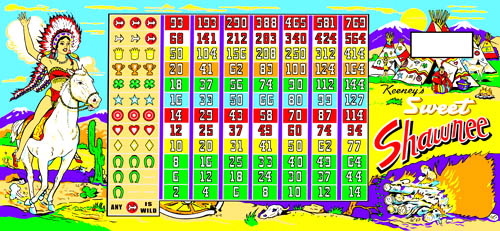
This slot-machine arcade game from the 1950's & 60's, by Keeney, sports an Indian gal as apparently gender-challenged as my grandma's portrait, with her (male) chief's headdress. At least Grandma didn't wear a bikini with her ceremonial headwear; nor was she silly enough to dress for the beach in a desert. And finally, who rides a horse with one's legs spread like a lewdly posed Barbie doll? (Thank God there's no saddle horn involved. I hope.) . . . [Later add:] Indeed, the (male) Plains-warrior garb, plus desert Southwest background, plus beach-blanket-bimbo bikini renders the whole thing an eyesore of racist incongruity. |
 |
|
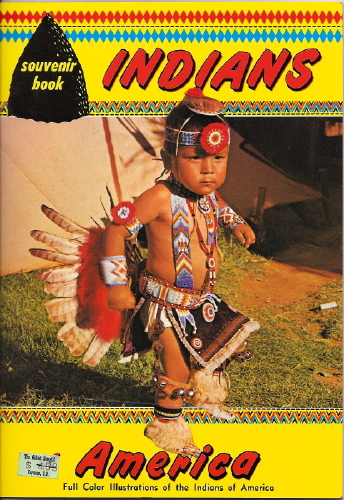
This tourist-trap booklet, Indians of America, has no publication date, but its design & layout smacks of the late 50's or early 60's. (Only a "corporate author" can be found, in very small print: LMG International; it was published in Hong Kong.) The price tag indicates that it was originally purchased in Keystone, SD, a Black Hills tourist venue; I assume that the same book was also sold at Wall Drug and many other "Wild West" tourism-driven establishments.
If you knew nothing about Indians, here's the real scoop, apparently: "American Indians - colorful, hard-working, fun-loving, and religious." As with much of the book's discourse, this is ostensibly a positive portrait, implying that Indians are like
the "rest of us." But the subtexts disrupt the "colorful" picture. What kind of religion did they practice? (The past tense, by the way, is symptomatically ubiquitous here.) Well, "Indians were very superstitious," and—gasp—"believed in many gods"; it's hard to believe that little Johnny-tourist in the back seat would deem such stuff valid religious practice.
As further examples of the book's unconscious-racist datedness, one photo is described as showing the Navajo "in their natural habitat," as if a species of wild animal; another section of the book is entitled "HEAP BIG INDIAN CHIEFS in Full Attire." (Ugh.)
Let me end my mini-review with a blurb from the book's intro: "So travel with us to the Land of the Indian, see him through our pictures and perhaps, dream a little as we go along." Exactly. For the book is much more "dream" or ideological illusion than reality.
|
 |
|
 |
||
|
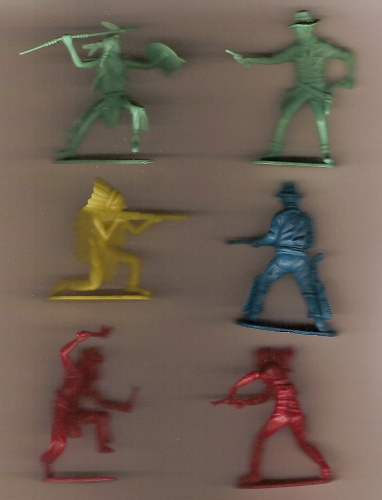
When I was a kid, we visited my cousin in Colorado, who had a set of over a hundred toy "Cowboys and Indians"—the fancy kind, with holes in their hands for miniature rifles, with tiny hats and holsters—the works. We envied him deeply and, when we actually got to play with them—we wanted to be the . . . COWBOYS, of course, never mind our "squaw" mother! (A famous soc./psych. study from some years back found the same sad state of affairs: minority children, they found, preferred to play with white dolls, due to their "normative" indoctrination by the mainstream culture.) . . . These "US [and U.S.] vs. them" toys are still being made. I just bought a set in 2004 in a Lincoln, NE grocery store, to "play with" in my Native American literature class (see my bad scan of some of the pieces, on the right). These are very similar to the "cheapo" versions my brothers and I owned in the 1960's. Even then we wondered what headdress-chiefs were doing firing rifles on foot, and what the "good (white) guys" were doin' fighting Indians with six-shooters (which we knew couldn't hit the side of a barn, unless you were Matt Dillon!). . . . Finally, the questionable tribal affiliation of the "Injuns"—if ascertainable at all (besides being "Plains ~" in general)—doesn't seem to prevent the possibility that they could be fighting each other, just as the cowboys would, if thrust together into a 1960's Gunsmoke bar scene. . . . |
 |
|
|
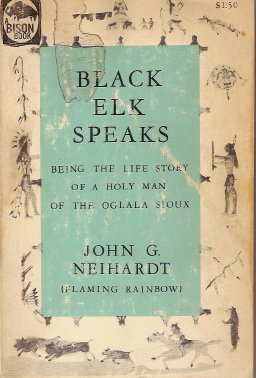
My more recent editions of Black Elk Speaks have actual photos of the titular fellow on the cover. But back in 1961, the Bison Press preferred a more exotic and primitivist approach. (This is a scan of my own copy, complete with aged coffee stains.) The flat-dimensioned images suggest that they might even be reproduced from some veritable traditional Lakota artist (e.g., Amos Bad Heart Bull). But rest assured, dear reader—the back of the book sets us straight: "Cover design by Betty Sieler." The back also includes a blurb from Oliver La Farge (of Laughing Boy fame): "Mr. Neihardt has a unique, realistic and[?!] poetic understanding of a vanished time and people . . . ." Indeed, it's a sad thing that Neihardt's general tone in this book reflects an earnest (almost) hope and wish that the Lakota are indeed "gone,"in support of his own nostalgic/primitivist agenda.
|
 |
|
The Andy Griffith Show has alway been a personal favorite of mine, but Mayberry was certainly a Southern monoculture of an enclave, with no room for the minority "Other." When the mythic West did occasionally appear in a storyline, that's exactly what it was—completely mythic. This witty repartee is from a 1963 episode called "Aunt Bea's Medicine Man" [dialogue verbatim, transcribed from VHS]: 8/07: I just saw a re-broadcast of this episode; and they've CUT the Shawnee/devils dialogue! |
--COLONEL HARVEY [hawking his 170-proof "Indian Elixir" to a Mayberry street crowd, and just having asked them if they suffered from being overweight or worried]: Have you ever seen a fat or a worried Indian? Have you ever met an Indian with ulcers? --BARNEY FIFE [aside to Andy]: I ain't ever known an Indian, have you? --COLONEL HARVEY: No! Why? Because the Indian's way is Nature's way. Nature's way is Colonel Harvey's way. Colonel Harvey's Indian Elixir: good for what ails you. [. . . later in the episode . . .] [At Andy's house after supper, COLONEL HARVEY makes bogus smoke signals with his cigar, performs some ridiculous "sign language" with his hands, and then pompously utters some "Native" macaronic gibberish.] --OPIE: Wow. --AUNT BEA [captivated]: Simply wonderful. --COLONEL HARVEY [explaining where he apparently learned these wonders]: Shawnee. I lived among 'em. They're devils. |
|
Another common trope in Western colonial discourse is the equation of Natives with the "wild," with the "bestial" & "animalistic." The Saturday-morning cartoon The Go-Go Gophers (1963-1964, 1968-1969) followed suit by rendering the two Native title characters as rodents named Ruffled Feather and Running Board. Okay, their cavalry opponents were animals, too—cartoon canines Colonel Kit Coyote and Sergeant Okey Homa—and the gopher pair always got the best of them; but the theme song remains the stereotypical highlight, as our Indians/animals are rendered ultimately imarticulate: |
MP3 excerpt from the Go-Go Gophers Theme Song
|
|
This extended skit from Firesign Theater's Waiting for the Electrician or Someone Like Him (1968) brilliantly mocks nearly every Indian stereotype in American culture. I give only a few highlights here (from a web transcript; revised [via original soundtrack, and with orthographic considerations], 4/04, TCG; including some added "stage directions" in [square brackets]): |
A Conquistador, a Padre, and several Spanish soldiers enter to a trumpet fanfare and flamenco guitar music. The buffalo scatter. [All of the newcomers but the priest have thick, exaggerated Spanish accents.]
The Spaniards leave and the Indians hide as a wagon train enters. One Pioneer plays "Oh, Susanna" on a harmonica. Another Pioneer speaks [in an exaggerated Western/"hick" drawl, as they all do]:
CONDUCTOR: Cain't go no further. This here's Injun Territory!
TOURIST: Howdy there, Colorful Replica of America's Past! When is the exciting-in-its-primitive-splendor Snake Dance going to take place?
The marching band gets off the bus, playing "America The Beautiful" [out of tune], followed by the Senator, who speaks: |
|
|
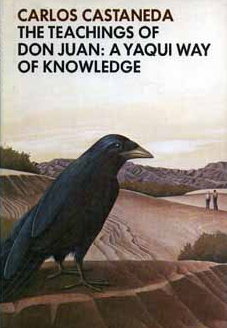
From the revival of interest in Black Elk Speaks in the hippie-era late 1960's, through the popularity in the 70's of such authors as Carlos Castaneda and Hyemeyohsts Storm, to the many current web pages out there making questionable claims for Indian "holiness"—well, "Indian Spirituality" has been/is still BIG. And usually for the wrong reasons. To what extent John G. Neihardt transformed (the already closet-Catholic) Black Elk's Lakota ceremonialism into a more monotheistic, ultimately Western, faith is still open to debate, as has long been Castaneda's supposed Yaqui-holy-man wisdom: yes, I read the first four books in the "Don Juan" series voraciously, as a wanna-be-hippie myself, but I already realized that these texts were much more "New Age" (with their syncretic blend of Western and Asian mysticism) than "authentically" indigenous, or veritably anthropological. Indeed, Castaneda's Don Juan character seems to be, even more obviously to me now, very much an invention of/projection-object for a certain "drug-culture" mentality. I'm not saying that the ceremonial use of natural hallucinogens wasn't/isn't common among Natives of the desert Southwest; I am saying that Castaneda sold books because many of his readers were white kids into LSD and mescaline, and/or into New-Age religion-seeking, in the wake of a shallow & hollow Christian upbringing. For ultimately, as the Western Civ. religious worldview has been found insufficent and bankrupt, Euro-Americans, especially, have had to look elsewhere . . . to co-opt and appropriate, in-"authentically," the "Other." (Pictured: Castaneda's first book in the "Don Juan" series" [1969]:) "Indian Spirituality" II (1990's page) |
 |
|
Someone once noted that maybe the best thing Indians do is "die, heroically"—especially in literature and song. In other words, after the genocide of the 19th century, white America has to keep killin' the Indians off—in art, especially in pop-culture representations. This song, "Running Bear," not only has the stock tragic ending, but dredges up the old "happy hunting ground" cliché. (The excerpt here is from Sonny James' 1969 country-western version. By the way, the song's composer, J. P. Richardson, was better known as the "Big Bopper.") |
MP3 excerpt from "Running Bear"
|
|
.gif)
 The sound dies away after a time, and the smoke clears, revealing the two Indians on horseback.